BALL x PIT vs Prism Siege: Ricochet Builds
Like the payoff of a well-placed ricochet? BALL x PIT combines bouncing combat with a broader progression loop. Our new Prism Siege takes a smaller, turn-based approach: choose an angle, flip a prism and defend a reactor. Here is what separates the official game from our original browser experiment.
View the official Steam page ↗
- BALL x PIT combines bouncing combat, ball fusion and base building
- Prism Siege lets you plan each volley with no aiming timer
- Charge balls with prisms, choose upgrades and clear twelve waves
- Independent games: Prism Siege uses original code and graphics
Play our original Prism Siege →
Why look at BALL x PIT now?
On November 5, 2026, its official Steam page showed 376 recent reviews with 90% positive. That suggests continuing interest, not a current sales-chart position. The store describes a survival roguelite with brick breaking, ball fusion and base building. Follow the official store link for the complete game.
What did we change for our browser game?
Prism Siege keeps the appeal of bouncing attacks and run upgrades, but turns the pressure into a planning problem. You fire from the bottom center. Enemies advance only after the volley ends. On a phone, you can study an angle without simultaneously dodging and aiming. Two prisms let you change the route before you commit. This is a compact independent game with no base building or persistent character progression.
How do you start your first run?
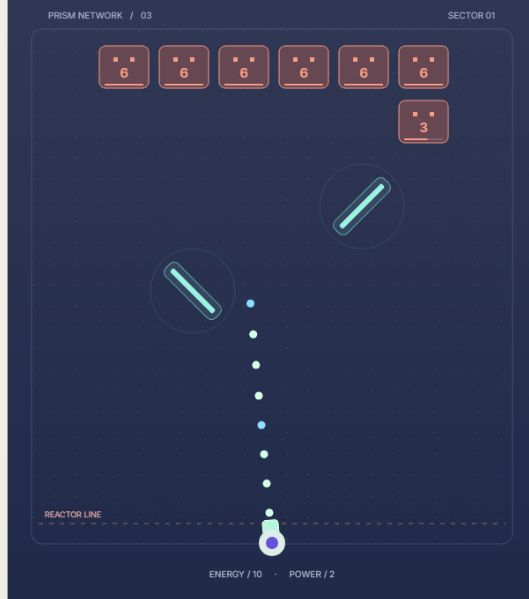
Choose Defend the reactor. Click or drag on the board to aim upward, then press Launch volley. The dotted line previews the first ball up to its first enemy hit; it cannot predict how the full volley changes the field after kills. Try a wall bounce that reaches the side or back of a group. Shooting straight up is simple, but may miss opportunities. Keyboard players can adjust with arrows, fire with Space, flip prisms with Q and pause with P. Touch uses the same aim-then-launch sequence.
How do prisms and upgrades affect a build?
A prism redirects and charges a ball. Its next hit deals extra damage and arcs to a nearby target. At the start of turns 3, 6, 9 and 12, pick one of three upgrades: extra balls, power, spark, frost, repair or prism amplification. The three choices vary. Frost stops a hit enemy from advancing once. Gold armor reduces ordinary damage by one, while charged hits bypass that reduction. Once frost is unlocked, another copy is not offered.
What wins or ends a run?
You have five shields. A normal breach costs one; an elite costs two. Losing every shield ends the run. Survive all twelve waves and destroy the remaining enemies to win; no new enemies spawn during cleanup. Volleys automatically return after nine seconds. Manual recall forfeits unfired balls and immediately advances enemies. It saves waiting time, not reactor damage. Only a best score is stored on this device, with no account sync.
Which experience should you choose?
For the broader commercial game and its progression systems, explore the official BALL x PIT listing and device requirements. For a short browser session built around angles and deliberate turns, try Prism Siege. Their shared appeal is ricochets and combinations; our particular experiment is a readable turn structure with controllable prism routes.
The original-game introduction is based on its official Steam page checked November 5, 2026, not a full playthrough. Review counts can change. Prism Siege is our independently developed short-session game; rules and balance may evolve. Neither game is affiliated with or endorsed by the other.